

WICKED and the Hard Work of Accountability
- Bryana Fern
- Nov 23, 2025
- 19 min read

Updated: Jan 9
Musical fans swarm theatres for the long-awaited conclusion over 20 years in the making

While I am against over-commercialization of practically anything, I ran to the theatre opening night with everyone else, donned with everything WICKED. Shirts, beanies, blankets, pointed hats, and more, Shiz alumni swarmed in everything green and pink. Munchkin children in Glinda dresses and tiaras parted the way with wands. Concession stands ran out of pink and green glitter popcorn toppings, character boxes, and special merchandise. My theatre had evacuated everyone earlier that afternoon for a fire hazard event, so our 8:30 showing was delayed, filling the lobby with waiting Ozians to such an extent that I hid in the photo booth and ate my green and pink popcorn, nervously waiting to be let in. My prescription lens Elphaba glasses from Shiz were a big hit.
When we were finally admitted, the film began immediately. No trailers. No posturing. Lights went down and the overture began.
What most people might not appreciate when it comes to the WICKED craze is that this project has been much-awaited for a very long time. WICKED debuted on Broadway in 2003, over 20 years ago, and Gregory Maguire’s novel was released even earlier in 1995. Music kids raised on Glee don’t mess around, and for we millennials, this was what we spent high school streaming on iPods and blaring on car CDs in the parking lot. We were defying gravity with Idina Menzel long before Cynthia Erivo brought her epic war cry variation to the big screen.

So I sat front and center, awkwardly crowded between two parties who had missed a seat in their booking. But it was the railing row, the perfect place for draping bags and blankets, and really settling in. For me, everything was perfect. Even when it wasn’t. After, when I stumbled out of the theater with my specialty popcorn tin, I couldn’t sleep. I spent hours at home reading reviews from others who’d stormed theaters opening night. Selfies of outfits, red and tear-blotched faces, popcorn tins. And immediate reactions.
It became immediately evident that people who’d not seen the musical, who did not know the narrative of the stage-story, had been less than impressed—if not straight up confused at the pacing. And I’ll admit that parts did feel rushed.
Five Layers of Influence into One Storyline

You have to appreciate just how many “texts” Jon M. Chu was dealing with for this project—especially the second part, which was the weaker half of even the Broadway musical. For Good incorporates elements from:
Frank L. Baum’s original novel at the turn of the twentieth century
The original film from 1939
Gregory Maguire’s novel released in 1995
Stephen Schwartz’s Broadway musical in 2003
Chu’s first film in 2024
That’s a lot to be loyal to. That’s a lot to fit in for just over two hours.
Many viewers complained that transitions felt choppy and rushed, but scenes that felt cut were ones from Baum’s novel and were not included even in the musical. We don’t see Dorothy in the musical. She’s not important. She’s not there at the destruction in Munchkinland—that’s purely for Glinda and Elphaba’s fight and Fiyero’s arrest. She’s not there in Elphaba’s castle—she’s locked below, told to get the shoes off her feet, and she’s shown in silhouette form only when she “kills” Elphaba and takes the broom.

Instead, it’s important to examine what was added. Though it felt sudden and abbreviated, almost comical, we see Nessa’s death on screen. We see her out searching for Boq in the storm, and we witness the house land on her. We see Madame Morrible causing it, casting it, and orchestrating it. We see Glinda’s private remorse at Nessa’s death, and her argument with Elphaba over Fiyero, including the comical laugh copy that causes even Elphaba to bite her lip in a grin. We see the slap and Ariana’s genuine reaction that sent the theater silent in equal shock and anticipation for Elphaba’s return slap.
And in the tower, we see the heart-wrenching aftermath of the “For Good” duet. Cynthia and Ariana created a non-scripted conversation for the scene, with Elphaba telling Glinda that she must learn to read the Grimmerie text. She hides Glinda in a closet when Dorothy and Co. arrive, telling her that everything will be all right, and “I love you.” Glinda returns her own, “I love you too.” And we see them on opposite sides of the closed door, breaking down in the knowledge that that was the last time they’d ever see each other.
They’re separated only by a door. But they’re worlds apart now. Lives apart.

And so, yes, the silhouette death that Glinda witnesses may have felt rushed. But that was because we’d already seen the only part that mattered.
We, too, had to feel as limited and helpless as Glinda in that moment. Shut away with only a partial view. Unable to do anything, since Elphaba forbade not only her intervention, but any restitution. She cannot vindicate Elphaba publicly. Whatever happens must be allowed to happen.
Together, Cynthia and Ariana created their own storyline that added layers of meaning to the original dynamic we saw 20 years ago between Idina and Kristin. But that’s not all they added.
Original Songs Emphasizing Accountability
“If you are neutral in the situations of injustice, you have chosen the side of the oppressor.” -Desmond Tutu
“All it takes for evil to prevail is for good people to do nothing.” -Edmund Burke (attributed)

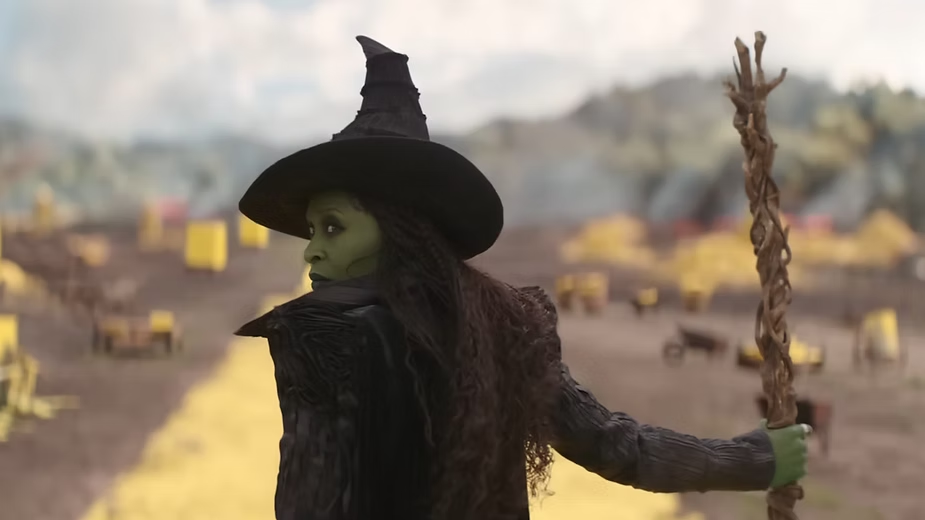
Cynthia Erivo was nominated for two Grammy Awards with the release of For Good. One is for her character’s original song by Stephen Schwartz, “No Place Like Home,” which was not included in the musical. This moment occurs on the Yellow Brick Road, which Elphaba has been working steadily to dismantle. The road is an environmental and ecological disaster, clearing and burning land and pushing animals farther from the only refuge they had anymore after they’d been banished from society.
The bricks themselves are sloppily painted a cheap yellow, a further metaphor of the cover-up of greatness it’s meant to provide for the Wizard. “All roads lead to the Emerald City,” whether or not you want them to. And it must look like a manufacturing marvel. A reflection of the greatness of the city and its powerful leader.
Elphaba discovers animals secretly leaving Oz via an underground network path beneath the yellow-brick road. An underground railroad of sorts. She begs them to stay and fight with her—if only she can prove to the people that the Wizard lies, everything will return to normal. No one has to leave. They say they have no reason to stay and further risk their lives. She herself should leave with them. She’s even more wanted than they are.
And, like every idealist in activism who believes in their cause and in the power of truth against corruption, she tells them it’s because they have a right to stay there. It’s their home. Elphaba’s lyrics in the song are telling and oh, so timely for the metaphor of America, of democracy, which—remember—was Gregory Maguire’s direct intent in the 1995 novel.
Why do I love this place
That's never loved me?
A place that seems to be devolving
And even wanting to?
But Oz is more than just a place
It's a promise, an idea
And I want to help make it come true
Why should a land have so much meaning
When dark times befall it?
It's only land, made of dirt and rock and loam
It's just a place that's familiar
And "home"'s just what we call it
But there's no place like home
Don't we all know
There's no place like home?
Echoing Dorothy’s sentiment toward Kansas, Elphaba applies it to Oz. This country is falling apart, and it seems to want to. No one realizes what is actually happening, how it’s corrupt from within, and instead, they cheer on the leader of lies. So why stay and fight for it when people evidently don’t want you to? Because it’s your home, too. It's a place that welcomes everyone, says Elphaba as she stands Lady Liberty-like.
"Keep, ancient lands, your storied pomp!" cries she
With silent lips. "Give me your tired, your poor,
Your huddled masses yearning to breathe free,
The wretched refuse of your teeming shore.
Send these, the homeless, tempest-tost to me,
I lift my lamp beside the golden door!"

And you critique it to push it toward what it’s supposed to be. To better it. It’s your home, and you won’t stand by and see everyone blindly destroy it by fighting the wrong enemies. By supporting racism and xenophobia and authoritarianism draped in patriotic language of protection to Make Oz Great Again.
When you want to leave
Discouraged and resigned
That's what they want you to do
But think how you will grieve
For all you leave behind
Oz belongs to you too
Those who would take it from you
Spout a lie to sell yourself
You go their way or go
It's them we'll be defeating
If we keep on repeating
There’s no place like home
The message: Don’t get caught up in the fear of propaganda and distracting headlines. The Wizard counts on your fear, on your submissive silence. Elphaba believes that exposing him as a liar is worth the fight. She desperately doesn’t want to do it alone, though. Erivo’s lyrics take the ever-relatable and desirable theme of belonging, and apply it directly to viewers who feel most affected by dismissal. By the outcast silencing.
Even in the interlude number, "Everyday More Wicked," Elphaba adds a spoken verse not originally in the musical:
When I stop the Wizard
All Oz will applaud
How I saved them from the Wizard
By revealing he's a fraud
If I can just make them believe in the truth
That all that he says is a lie
That's when they'll finally bid
The Wizard goodbye
It's an ironic and heartbreaking twist from the melody and message of her early anthem at Shiz in "The Wizard and I":
When I meet the Wizard
Once I prove my worth
And then I meet the Wizard
What I've waited for since, since birth
...
He'll say to me, "I see who you truly are
A girl on whom I can rely"
And that's how we'll begin
The Wizard and I
Elphaba is able to do a 180 switch when she sees behind the curtain. And she remains certain others can, too, that people will realize she's been fighting for them the whole time. She believes in and idealizes the role of truth in a society that decides for themselves what that is. She cannot drag Oz from their Platonic cave no matter how much she points at the light. They all prefer the show on the wall--Oz the Great and Terrible.
Elphaba believes not only in the power of truth, but in the ability of her people to be transformed by it. It's the bare minimum, after all. But she herself already admitted that Oz seems to desire its dissolution.

Elphaba's song, though, is not the only one to add context to accountability. Glinda's song does the same, but turns that accountability inward.
Grande uses a similar tactic in her own original song with Schwartz, “The Girl in the Bubble.” We see a flashback to Glinda’s birthday party in her childhood home, which is high on a mountain above the clouds, literally above the problems of people below. Her view of the world is literally limited and privileged in perspective. After her wedding to Fiyero is ruined by Elphaba’s activism and she realizes she was a fool to believe Fiyero would also join her in complicity, she’s confronted with the truth of her choices.
There's that beautiful girl
With a beautiful life
Such a beautiful life
Built on lies
'Cause all that's required
To live in a dream
Is endlessly closing your eyes
She spins such beautiful stories
To sing her to sleep
Full of magic and glory and love
She's the girl in the bubble
The bright shiny bubble
Blissfully floating above

At her birthday party, when she is unable to use magic with her wand, she plays along when her friends think she made the rainbow. She claims the praise and accomplishment. Her mother tells her that the most important thing in life is to remember how loved she is by everyone. And that’s indeed what we see of her at Shiz and afterward when she joins the Wizard instead of Elphaba. Fiyero blames her for going along with the regime when she knows it’s all a lie. She isn’t threatened by it, though. It’s not hurting her.
“Why not make the best of it?” is not an option when the same it leaves everyone else in the absolute worst.
Madame Morrible confronts Glinda when she questions Nessa’s death as an accident, telling her she may have everyone else fooled as being a good person, but she’s just as guilty for playing along for power. All she’s been rewarded is what she asked for—what she always wanted. She knew what was happening the whole time. And Morrible shoves her so that she falls into the gigantic pile of propaganda flyers drawing Elphaba in extreme caricatures of evil danger. She literally sits in the mess she's made.
Michelle Yeoh was directed to frighten Ariana Grande when she turned and shoved her, and her expression was so severe that Glinda's gasp is a genuine reaction from Grande (who actually popped out one of her contact lens).
You don't get to be virtuous all of a sudden when it matters. You can't support an entire agenda and back an entire campaign and then retract yourself from the responsibility of it. You can't change your tune when you helped set the key. At least, not without creating a new score, and upsetting all the ones who'd memorized the old one. You can't Lady Macbeth your way out of bloody hands by scrubbing away the evidence.

Glinda has to sit with the acceptance that she belongs to the oppressive order and has been just as instrumental in its success by going along with it. By not doing what Elphaba has been brave enough to do. Her idealism is the opposite of Elphaba’s. She believes that going along with a lie won’t really hurt anyone, especially since it’s helping her. And Elphaba believes that once people realize the lie, they will change. Glinda’s lyrics highlight what we have all been waiting for her to realize: doing nothing is doing everything…wrong.
Ah, but the truth has a way
Of seeping on in
Beneath the surface and sheen
And blind as you try to be
Eventually
It's hard to unsee what you've seen
And so that beautiful girl
With a beautiful life
Has a question that haunts her somеhow
If she comes down from the sky
Givеs the real world a try
Who in the world is she now?
And though so much of her wishes
That she could float on
And the beautiful lies never stop
For the girl in the bubble
The pink shiny bubble
It's time for her bubble to pop.
The rose-colored glasses of the bubble’s exterior have to be removed. She can activate and deactivate the bubble so easily, with just a tap. But she's abused that privilege. She has to actually take charge now and become a traitor to her own class. To her own people. Who is she if she's not what everyone expects her to be--has shaped her to be? Not even Glinda knows.
After all, she "couldn't be happier."
We Call it History
“Lying is done with words, and also with silence.” -Adrienne Rich
“Lying is a cooperative act. A lie has no power by its mere utterance; its power emerges when someone else agrees to believe it.” -Pamela Meyer

The film crafted a very different introduction to even in the most telling song of all, “Wonderful,” which is an original to the musical.
When Joel Gray began the song on stage, the intro contained:
I never asked for this or planned it in advance
I was merely blown here by the winds of chance
I never saw myself as a Solomon or Socrates
I knew who I was, one of your dime-a-dozen mediocrities
Then suddenly I'm here, respected, worshipped, even
Just because the folks in Oz needed someone to believe in
Does it surprise you I got hooked, and all too soon?
What can I say? I got carried away, and not just by balloon
The message seems far more indirect. It's not my fault. He didn't orchestrate the lie--he just went along with it when they presented it. "I guess I just wanted to give the citizens of Oz everything," he says.
The film takes a far more direct approach:
Take it from a wise old carny
Once folks buy into your blarney
It becomes the thing they'll most hold onto
Once they've swallowed sham and hokum
Facts and logic won't unchoke 'em
They'll go on believing what they want to
Show them exactly what's the score
They'll just believe it even more
He very clearly acknowledges how he knows to manipulate people. He's seen it done before. He knew that this was something he could go along with.
Glinda, too, directly involves herself in perpetrating the lie. “It feels wonderful,” she admits. Everyone calls him wonderful, and truth is only what everyone agrees on, so why not go along with it? (That line about truth is also an addition unique to the film and not the musical.)
"Wonderful"
They called me "Wonderful"
So I said, "Wonderful"
If you insist
"Wonderful"
I will be wonderful
[GLINDA & WIZARD]
Believe me, it's hard to rеsist
'Cause it feels wonderful
[GLINDA]
They think hе's wonderful
[WIZARD]
The truth is not a fact or reason
The truth is just what everyone agrees on
[WIZARD, spoken]
You see, back where I come from, we got a whole lot of people who believe all sorts of things that aren't true
You know what we call it?
History
[WIZARD]
A man's called a traitor or liberator
A rich man's a thief or philanthropist
Is one an invader or noble crusader?
It's all in which label is able to persist
There are precious few at ease with moral ambiguities
So we act as though they don't exist
[GLINDA]
They call him, "Wonderful"
[WIZARD]
So I am wonderful
[GLINDA]
He is so wonderful
It's part of his name
[GLINDA & WIZARD]
And with our help, you can be the same
The Wizard highlights the corruption of America, where he comes from, and unashamedly repeats the cycle here in a new country of fools who will believe whatever they want. Even if you try to tell them the truth, he stresses, they won’t believe it. Once people buy into the lie you’ve presented, they’ll cling to it and fight anyone who tries to open their eyes.
Without sunglasses, the world is too bright. And there's no time for transition lenses.
In essence, you can put soldiers on the street to abduct as many people as you want, you can cut as many traditions of education as you want, you can enforce as many racist, misogynistic, xenophobic policies as you want, destroy as many historical foundations as you want, call women whatever you want, pardon as many rulers as you want, employ as many environmentally dangerous acts as you want, and people won’t mind. It won’t bother anyone.

And the most dangerous part is that they both bring Elphaba into the fold. The wild psychedelic colors and wonders and dances in the hall almost convince her with their nostalgia of her original loyalty to the Wizard and to her original dreams with Glinda. The reprise of their song comes back, along with their dance moves from the Ozdust Ball, and even the quiet moments of persuasion when it’s just the two of them, are powerful in their effect. Elphaba almost breaks down. “They’ll call you wonderful,” Glinda tells her, along with the Wizard. Nothing’s too late.
[GLINDA, spoken]
Elphie, think of what we could do
Together
[GLINDA]
Unlimited
Together, we're unlimited
Together, we'll be the greatest team there's ever been, Elphie
[ELPHABA]
Dreams the way we planned 'em
[GLINDA]
If we work in tandem
[GLINDA & ELPHABA]
There's no fight we cannot win
[WIZARD]
At long, long last, receive your due
[GLINDA]
Long overdue
[WIZARD]
Elphaba
A celebration throughout Oz that's all to do
With you
[GLINDA & WIZARD]
Wonderful
They'll call you, "Wonderful"
[GLINDA]
Come and be wonderful
[WIZARD]
Trust me, it's fun
[GLINDA]
We will be wonderful
[WIZARD]
You'll make me wonderful
[GLINDA & WIZARD]
Wonderful, wonderful
It can all go back to what it was before. We can make everything great again. Just sign on the dotted line. “Come and be wonderful,” she says. You, too, can have giant banners over buildings with photos of you, celebrating your patriotic greatness and power. Just…stop fighting.

And Elphaba does. She accepts a compromise. She abandons her promise.
Don't worry, the Wizard essentially says. We'll get to the rest later--I promise. Just agree with me on this so we can end this shutdown. Stop being so difficult. You're the reason we can't get anything accomplished. Oz is suffering because of what you’re doing. Your friend here is suffering. You care about the animals? Great. Okay. We’ll come back to that, I promise. Here, I’ll even let the monkeys free. Will that appease you?
Appeasement is what it comes down to. Will you accept that I’m still doing horrible things if I even the score a little bit? I’m the most powerful person in the country. I can do that for you. No one will stop me. No one will question me.
Thankfully, Elphaba realizes the truth, thanks to Chistery—the monkey she first transformed. She sees how many animals are still imprisoned. Unaccounted for. “Some animals will always be dangerous,” the Wizard tells her as an excuse when he realizes she’s seen past him again, when she’s discovered them locked in chains in darkness beneath the ballroom, like slaves in the hold of a ship. Dr. Dillamond is included front and center, and he can no longer speak, like any of them.

In a way, Chistery saves the day when he absolutely didn’t have to. Yes, Elphaba freed him and he witnessed her song in the forest with the animals and listened when she apologized to him—that she’d never have read from the Grimmerie if she’d known she was being tricked. But that doesn’t mean he has to accept her apology. That he has to let her into his space as one who’s been oppressed by her. But he reminds her, in essence, not to fall for the trap. She’s being deceived again.
Wake up. And stay awake.
She’s been using the tools of the oppressor all along through the Grimmerie. She tries to use the language for good, use it against them, but it always brings unforeseen consequences. She always makes things worse, which is why she’s so relieved when she thinks she’s finally used her powers for good in helping Nessa. But her words are always used against her. Even in spelling out, “Our Wizard Lies” in the clouds, Morrible changes them to “Oz Dies,” which—of course—is all the Munchkins see. She can’t be seen as the hero while using the Wizard’s tools.

Individual activism in place of collective liberation is a death sentence for intersectional equality.
The dangerous appeal: You want to be seen as great by liberating everyone, by standing up for everyone. Look what a great activist I am. Look how much I’m helping. If you accept the praise, though, you’ll be blinded into making it all about you. Even if you’ve been oppressed yourself, you cannot become allies with the oppressive class that tries to reward you in order to ultimately secure your silence.
What a great person you are is all you need to be told in order to join forces for more praise. And you forget the reason you started fighting in the first place. The reason you wanted to start fighting. You can't do it all yourself anyway, so why not compromise if it gets you closer to the larger goal?
"No one believed in you more than I did," she tells the Wizard. And before the night is over, she remembers why.
Accepting the Consequences
“I am not free while any woman is unfree, even when her shackles are very different from my own.” -Audre Lorde
“The truth is, no one of us can be free until everybody is free.” -Maya Angelou

Both Glinda and Elphaba must accept what they’ve chosen in the end. Elphaba accepts, claims the title of wickedness if that’s what Oz wants to believe as the truth. You cannot be an activist while remaining loyal to what you want others to see you as. You must be seen as a traitor to do the work that needs doing. Accept that as the cost and work toward collective liberation.
Sympathy for the oppressors is always dangerous. Similarly to Guillermo del Torro’s recent Frankenstein, the Wizard, like Victor, is granted sympathy at the end. We see him realize he’s been part of killing his own daughter. We see the regret, just like we see Victor come to terms with the oppression of his own “child.” Elphaba is no longer there for him to beg forgiveness, the way Victor asks the Creature’s forgiveness. And we never see him close-up again. He gets an easy exit from his mess. An easy fix. An escape free of accountability.
A reverse deus ex machina occurs in order to make way for a new one: the Wizard leaves by balloon and Glinda takes his place by bubble.

If anything, Glinda still finds a way to avoid public accountability, still focusing on acceptance. Sure, she comes to terms with her mistakes. She banishes the Wizard. She removes Morrible from influence. But she is still guilty, and she is still responsible, and instead of becoming a traitor by calling out the others of her class in Oz for guilt in complicity, she continues to stay silent. Yes, Elphaba may have begged her to stay silent, but she still lets the Munchkins get away with their racism and gullibility. She doesn’t correct them. She doesn’t constructively criticize Ozians about their blindness and staunch refusal to see past propaganda. Instead, she wants to “help them” through the tough times to come by embodying the title they’ve given her: Glinda the Good.
Yes, this is the narrative of the musical. Yes, Glinda can’t perform her new activism the same way Elphaba did. We are left to assume (and hope) that she will begin holding Oz to more accountability in the future. The animals are welcomed to return. And they choose to, to once again live among the same people who wanted them exiled illegally just a few months ago. Who wanted them abducted and silenced.


Elphaba, instead, is the one who leaves, despite saying at one point, in her idealism and naïve hope, that she never would. She comes into our world, we’re left to believe, despite no one ever knowing how they’d survive there, as the animals once admitted in their escape.
If we learn the lesson well, we’ll begin to see Elphaba as the model. We’ll see her in our streets, our classrooms, our households. Our holiday tables with family. Our tariff-weary factory farms, our unethical detention centers, our gaudy ballrooms, our restructured art centers. Our theatres.
Theatre kids know how to get it done. We in music and the arts have grown up feeling our own sense of ostracism. The power of music, of ideas, of beauty and goodness, unite us. Cynthia and Ariana cried on nearly every press tour interview last year, as they’ve done this year. They were criticized relentlessly online for it. But now, perhaps, more people are realizing why. They’re realizing the power of art, of this story, of a friendship that can reach the heights of idealistic wonder, the depths of realistic confrontations, and the middle ground of acceptance and accountability.
I like to believe that Glinda realized Elphaba was alive there at the end when the Grimmerie opened for her. Many theatre-goers needed confirmation, though, and they decoded the opened page using one of the special popcorn tin codes and the official translation key on the film's website. The result? Translated, the incantation on the left page reads, "Heal, mend, sinew and skin. Heal, mend and hasten. Feed the wound, cover the bone. Heal mend and revive. Pain & fear allayed when true magic applied." On the right page, the incantation reads, "Heal. Revive. Nature so willing be soothing, powers conspire from me. Mend. Mending deftly to the wound. Easing quickly soon ensues. Fear & pain now set aside."

Interestingly, the text can be seen to support the continued lack of accountability. Glinda helped create this wound, but now she can use her powers to ignore it and "heal" from it. She has the power to apply "true magic" in a way that suggests Elphaba could not. Again, this role is an extended place of privilege that the rest of Oz is not afforded. It is not the job of the oppressed to comfort the oppressor and assuage their guilt.

Up until the end, it seems that Elphaba retains part of her idealism. She forgives and soothes when that is neither her job nor her responsibility. She is still, and always will be, the protector. And we must recognize the work Glinda puts in--it takes bravery and courage to feel like the only one stepping out in new knowledge. Activism is vulnerable, and the first step is always the hardest. Glinda has come a long way for Oz, if only because she had the best model to show her what risk really entails.
If we just keep fighting for it
We will win back and restore it.
Even when she's not there, Elphaba loves her country. She cherishes all that it can be despite its failures. For her, the reason is simple: there’s no place like home.


Comments